


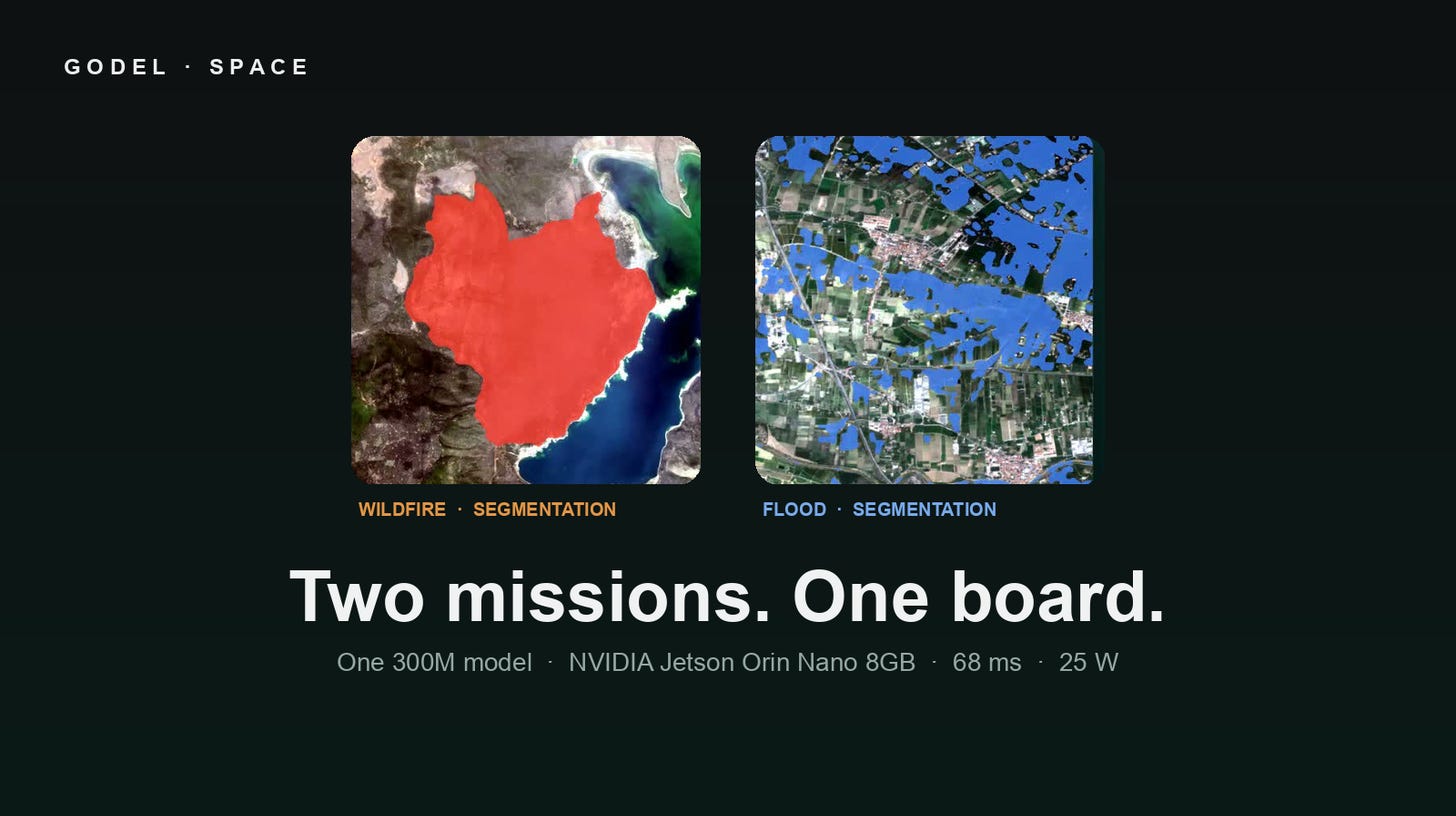
A wildfire and a flood do not look alike. One is a burn scar spreading through dry country. The other is water where a river used to have banks. For years, telling a satellite to find both meant two models, two pipelines, and a ground station with room to run them. The satellite would capture the scene, wait for a pass over a receiving station, dump the raw data, and let a datacenter sort it out hours later. By the time the answer came back, the fire had moved and the water had risen.
We put both missions on one board.
One 300M-parameter model. Wildfire burn-scar segmentation and flood segmentation, running on a single NVIDIA Jetson Orin Nano, the 8GB board, at 68 milliseconds per inference in FP16, inside a 25-watt envelope. Not in a lab rack. In the power and thermal budget a satellite payload gives you. The board looks at the scene and decides what matters before anything goes to the ground.
That last part is the whole company. A satellite senses far more than its downlink can ever carry home. The link is a straw and the power budget runs on watts, not racks. So the intelligence has to live where the data is born, judge the scene on its own, and send down the answer instead of the raw pixels. A burn scar that grew since the last pass. A coastline that moved. The thing a responder needs, in the minutes it still matters, not the terabytes they will never open.
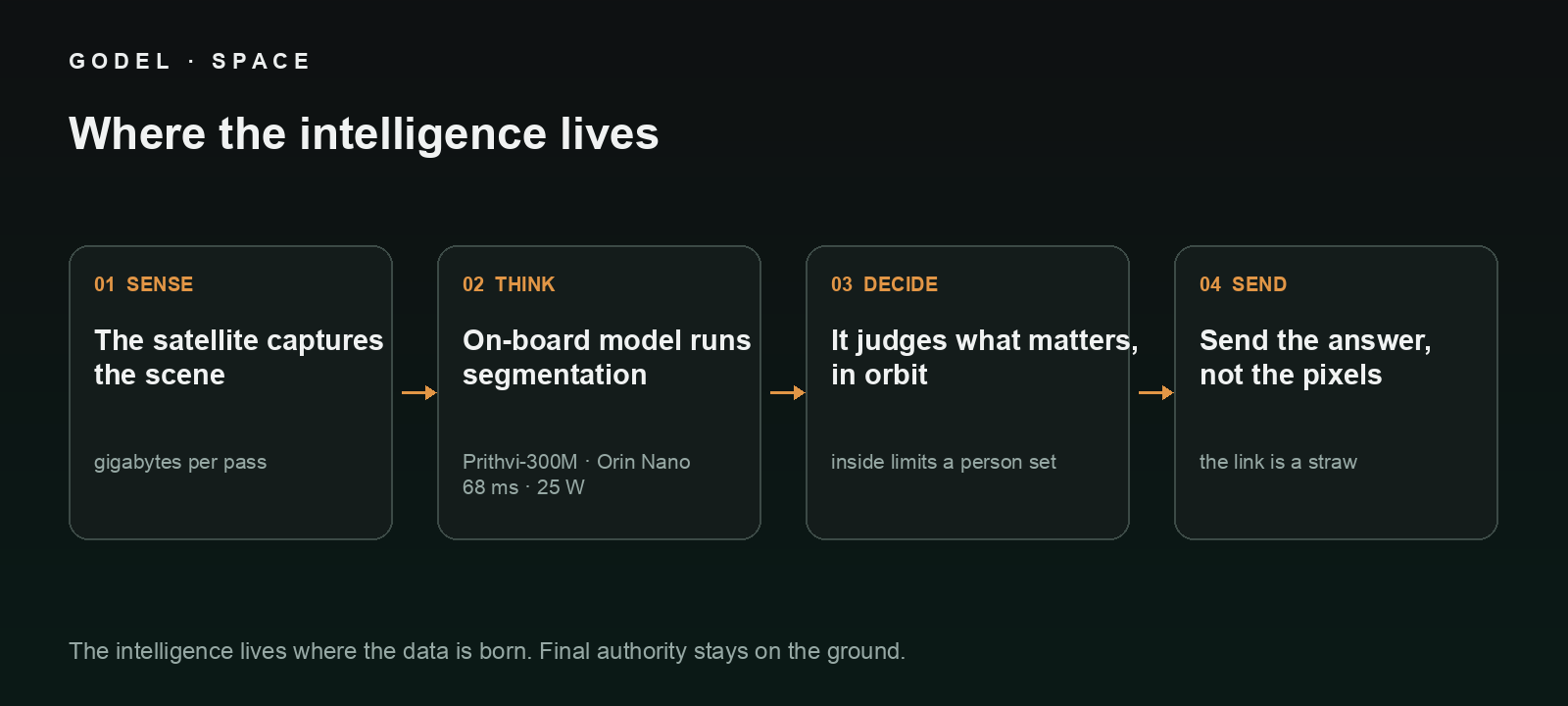
Making that work is not a matter of shrinking a model until it fits. It is engineering under constraints that punish hand-waving. Every watt the model spends is a watt some other subsystem wanted. Every millisecond counts against the next frame. You cannot add a rack, page an on-call engineer, or push a hotfix while the vehicle is over open ocean. The code earns its place in the silicon or it does not fly. The people who do this well treat those limits as the interesting part. They have shipped things they could hold in their hands, boards and radios and cameras, and they know the difference between a demo that works on a slide and a system that holds at 2 a.m. with nobody watching.
There is a line we hold through all of it. The machine acts inside limits a person set. It makes the calls the rules allow and no others, and final authority stays on the ground with a human who can read what it did and overrule it. An agent in orbit amplifies human intent. It does not replace human judgment. Space is the hardest place to honor that line, because the same scarce link that carries the human’s voice is the resource the agent exists to conserve. That is why space is the right place to prove it. Keep the machine inside its box when the box is overhead and the operator is asleep, and you have learned something true about autonomy everywhere it matters.
Two missions on one board is one stage. We are building the capability in the open, one stage at a time, toward a larger demonstration later this year. The next stage is more missions, then satellites that hand work to each other with no ground in the loop, always inside the human line. Each stage is a real system on real hardware, not a render. We label the concept footage as concept and let the working parts speak for themselves.
I am building a small team to do this. Small on purpose, where you own your piece of the problem outright and answer for it, and there is no crowd to hide in. If the constraints in this essay read as obstacles, this is not your problem to solve. If they read as the reason to show up, you already know what that feels like. The work is here, and it is getting harder in the good way. Come find me, and tell me what you would build.