


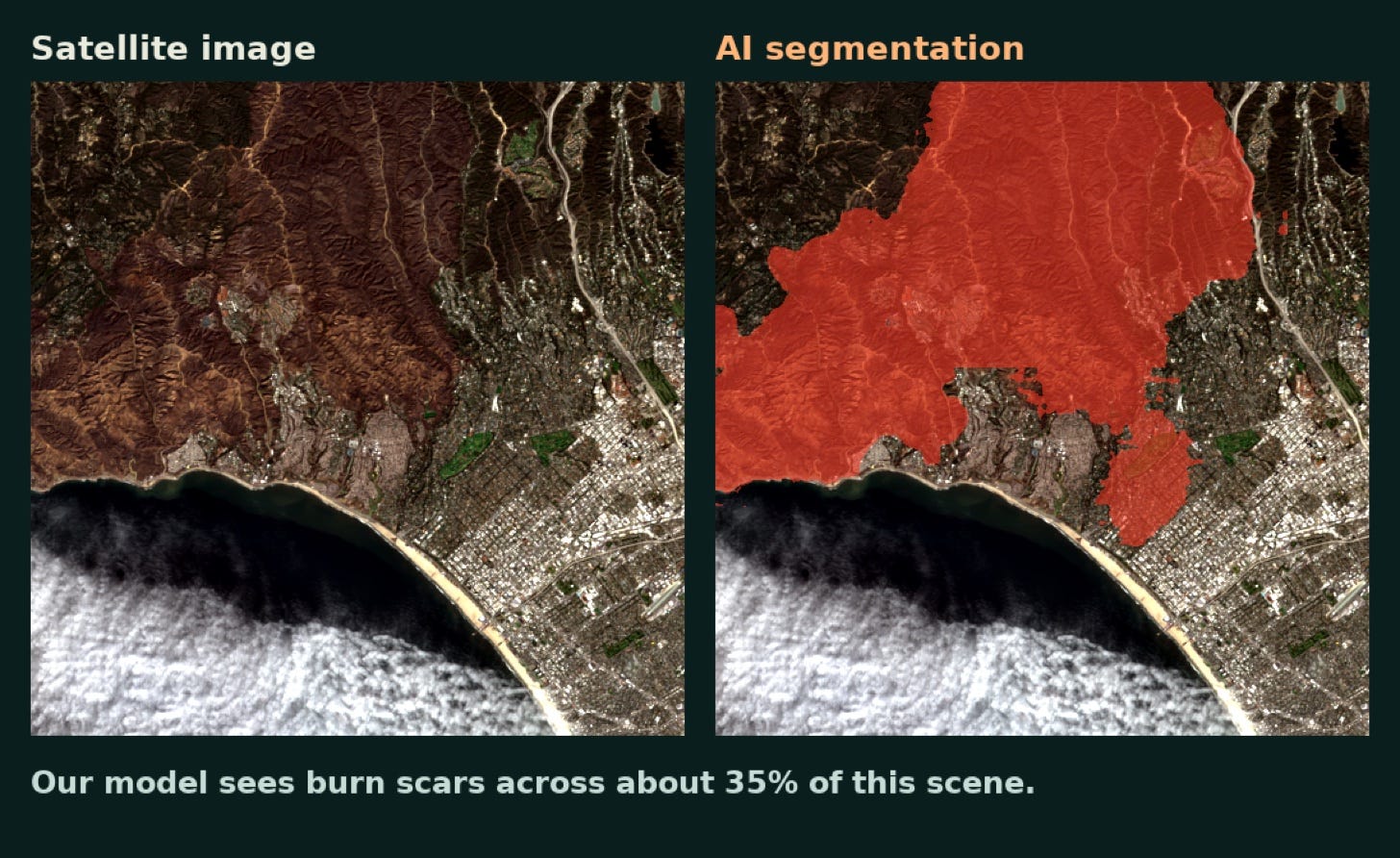
Godel runs earth observation AI on satellite-class edge hardware. Today we are opening the first public release of the surfaces we build on: a remote MCP server for agents, an HTTP API for applications, and downloadable geospatial data products.
Connect an agent in one line:
# Claude Code — other MCP clients at try.godel.space/build
claude mcp add --transport http godel-analyze https://try.godel.space/mcp
Then ask it to analyze a scene.
What a result looks like
Every analysis returns three things: an answer a person can read, evidence a machine can check, and data your GIS can load.
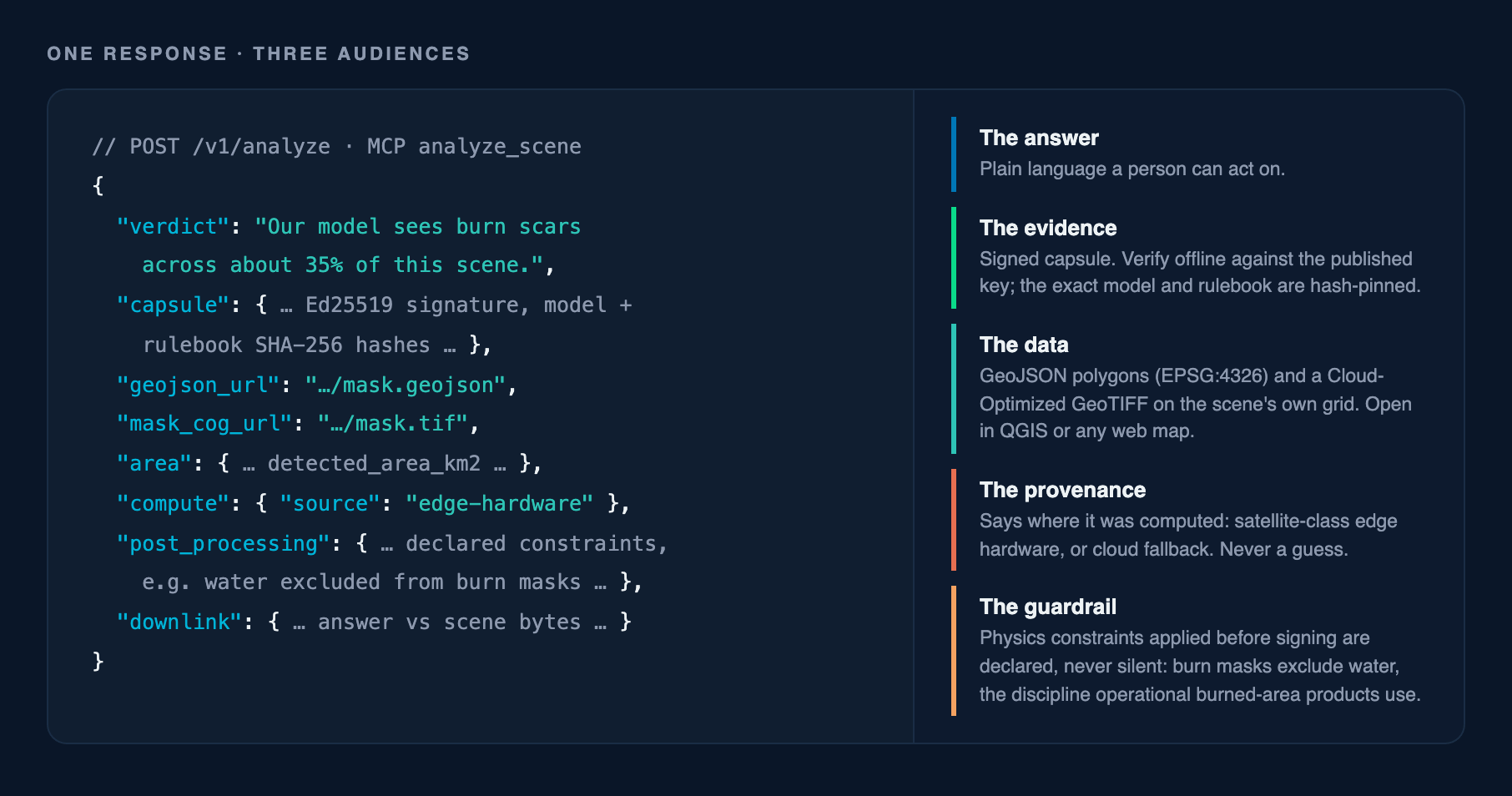
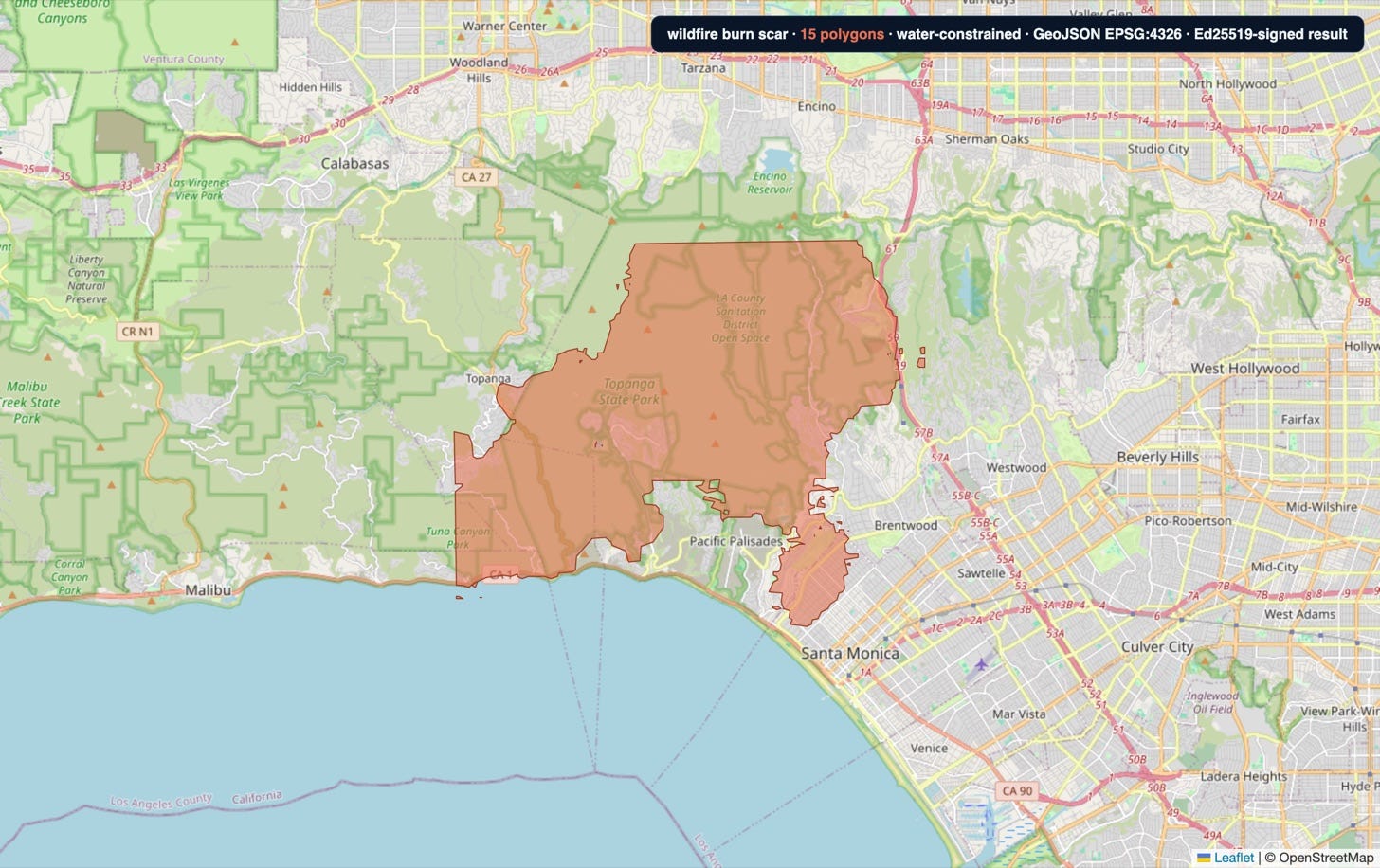
The verdict is plain language. The capsule is signed evidence: the observation, the statistics, and the hashes of the exact model and rulebook that produced them. The data products are the detection as data: polygons as a GeoJSON FeatureCollection in EPSG:4326 with per-feature area, and the mask as a Cloud-Optimized GeoTIFF on the scene’s own grid. Both open in QGIS or any web map.
Verify it yourself
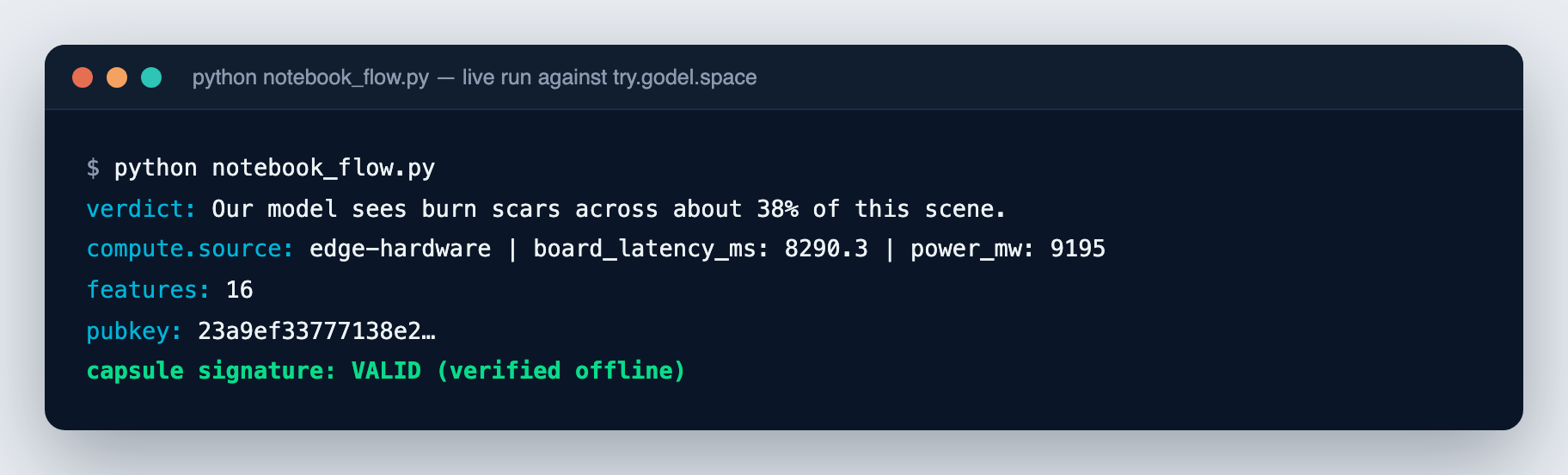
You do not have to trust us. The service publishes its key at /v1/pubkey, and the signature check runs offline:
from cryptography.hazmat.primitives.asymmetric.ed25519 import Ed25519PublicKey
cap = dict(result["capsule"])
sig = bytes.fromhex(cap.pop("signature_hex"))
Ed25519PublicKey.from_public_bytes(bytes.fromhex(pubkey_hex)).verify(
    sig, json.dumps(cap, sort_keys=True).encode())   # raises if altered
If we changed one byte of the result, one weight of the model, or one line of the rulebook, this check fails. It is the same signed-provenance discipline a Godel edge node runs, exposed publicly. On scenes with public reference masks, the result is also scored live against the reference, and the score ships with the answer, including where it is modest.
The notebook
The sample notebook goes from an empty Python environment to a verified result on a map in five cells: connect to the MCP server, run an analysis, download the GeoJSON, render it, verify the signature. The MCP server is the programmatic path: the web API’s analyze endpoint carries a human check, so scripts and agents connect over MCP. Every cell ran against the live service before we published it.
from mcp import ClientSession
from mcp.client.streamable_http import streamablehttp_client

async with streamablehttp_client("https://try.godel.space/mcp") as (r, w, _):
    async with ClientSession(r, w) as s:
        await s.initialize()
        result = await s.call_tool("analyze_scene", {"scene_id": "palisades_2025"})
The run above answered from real edge hardware in a few seconds at under 10 watts, and the payload says so: compute.source reads edge-hardware with live power draw. When the edge node cannot answer, the cloud does, and the payload says cloud-fallback instead. You should not have to guess where your answer came from.
Bring your own scene
The curated gallery is six real disaster scenes. Past that, search_scenes finds imagery over any area you name from public catalogs, and analyze_stac_item runs the model on the scene you pick. Same payload, same signature, same downloads.
What we chose not to expose
This surface is bounded on purpose. Public models on public imagery, a curated gallery plus catalog scenes, no arbitrary uploads. The interface and the proof are public; the training and optimization work behind the model is not. We would rather ship a small surface that holds up under inspection than a large one that needs caveats.
The flood mission
Floods run on the same surface with mission: “flood”: same payload, same signature, same downloads. Rather than doubling this article, see it live: pick the Spain farmland flood scene at try.godel.space and download its GeoJSON from the result view.
Where to start
The live demo is at try.godel.space. Endpoint reference, per-client setup, and a curl example for every endpoint are at try.godel.space/build. The sample notebook is at github.com/godel-space/cookbooks. Agents can self-discover the surface from llms.txt. If you are evaluating this for a government or commercial mission, write to us at godel.space.